Menu
member login contact link

An organisation is only as successful as its teams

In a complex, uncertain and fast-moving world, teams are the building blocks of organisation health – the key link between individual talent and business outcomes.

Building high-performing teams should be amongst the key priorities of every business.

Building High Performing Teams: Why Data, Behaviour and Shared Purpose Matter

“High performing teams” is one of the most overused phrases in modern organisational life. We hear it everywhere: in strategy meetings, leadership workshops and company away days.

Yet truly high performing teams are remarkably rare. Authors such as Katzenbach and Smith, Patrick Lencioni and James Scouller reinforce the same message.

A high performing team is not something you simply assemble. It is something you become over time through deliberate design, shared commitment and continuous development.

Importantly, once a team reaches high performance, it does not stay there automatically. Context, objectives and people all change. Teams must adapt continuously.

Talk to us today

Belbin: "completely life-changing for our teams"

"I do a lot of team coaching and at the moment quite a few teams have been asking me to come in and help them to become higher performers. And I found bringing in Belbin has been a fantastic way to look at the teams. To look at how they are conflicting with each other, looking at how they are complementing each other... People have actually said this has been completely life-changing for our teams."  

What Do We Mean by “Team”?

The word “team” is now used so widely that it has almost lost its meaning. We routinely call any group of people a team. Departments, working groups and project clusters often fall into this category, but many of these are not teams in the true sense.

Katzenbach and Smith define a team as:

A small number of people with complementary skills who are committed to a common purpose, performance goals and approach, for which they hold themselves mutually accountable.

This gives us five critical components:

  • Small number of people
  • Complementary skills
  • A shared purpose
  • Joint performance goals
  • Mutual accountability

High performing teams think in terms of “we”, not “I”. They prioritise the collective objective above individual agendas.

Working groups, by contrast, operate primarily through individual accountability to a manager. They function effectively for business as usual tasks but are not designed for innovation, complexity or cross functional problem solving.

Talk to us today

The Foundations of High Performance

A Clear Shared Objective


A team cannot perform well if everyone is working towards a different destination. It sounds obvious, yet many teams begin without a genuinely shared understanding of why they exist.

One facilitation technique is simple and effective.  

Ask each person to privately write down the team’s objective. Then compare their answers. The differences often reveal the real barriers to alignment and performance.

The most effective objectives are co created rather than handed down. Co creation drives clarity, ownership and accountability.

Belbin LI Quotes5

Time Spent Off the Playing Field

Elite sports teams spend the majority of their time practising how they will work together and only a fraction of their time actually competing. Yet most organisations do the opposite. We rush straight into delivery without practising collaboration.

Teams need deliberate time to:

  • Establish ways of working
  • Understand each other’s strengths
  • Anticipate friction points
  • Build trust
  • Make joint decisions about how they will operate

Skipping this step is one of the most common reasons teams never progress beyond forming.

Talk to us today

“It is not the individual but the team that is the instrument of sustained and enduring success.”

Antony Jay, foreword to 'Management Teams, Why they Succeed or Fail' by Meredith Belbin

Metrics, Not Gut Feel

McKinsey’s 2024 work on team effectiveness concluded that exceptional teamwork must be treated as a science.

Teams require clarity on their objectives, the timescales they are working to, the budgets available, the stakeholders involved, the measures by which success will be judged and the specific roles and contributions each member is expected to make.

Facilitators, coaches and leaders should also ask a crucial question: how will we be measured?

If this planning takes two full days, it is time well spent.

Providing The Science Behind Team Performance For Over 40 Years (1)
Belbin LI Quotes10

The Role of Individual Behaviour

High performing teams begin with individuals who understand their strengths and how they contribute to collective performance.

Belbin Team Roles provide a behavioural language and framework to support this understanding.

A Belbin Team Role is a cluster of behaviours that have been shown to contribute to team success. 

Key principles include:

  • Not every Team Role is needed at every moment
  • Individuals typically bring strengths in two or three roles
  • A balanced team is not one where everyone does everything. It is one where the right behaviours appear at the right time
  • Too much of any one behaviour can create dysfunction

This behavioural insight allows teams to avoid predictable problems and leverage diversity effectively.

Better staff engagement, harmony and business results

"We chose Belbin as it examines actual behaviour traits rather than your base personality.  It seems more accurate as it takes into account other people’s view of you rather than assuming that everyone is going to be self-aware enough to generate accurate assessments of themselves. We also liked the idea of team exercises to learn about each other, and there’s nothing else out there that can do what Belbin does."

Harry Thuillier, Director and Co-founder of Oppo Brothers.

Read more
Oppo Belbin 4

Self Awareness: The Critical Ingredient

Teams rely on individuals who understand:

  • Their strengths
  • Their weaknesses
  • How others perceive them

Dr Tasha Eurich’s research suggests only 10 to 15 percent of people are truly self aware. Belbin’s ongoing research indicates the number may be slightly higher but still low.


Belbin supports both:

  • Internal self awareness: how I see myself
  • External self awareness: how others see me

Because Belbin measures behaviour rather than personality, others can reliably observe and validate it. This produces a far clearer picture of:

  • Which contributions are valued
  • Where blind spots lie
  • How individuals can flex to support the team objective

This is where performance begins to accelerate.

Talk to us today
John Yellow Page 5 Showcase Belbin Team Role Report
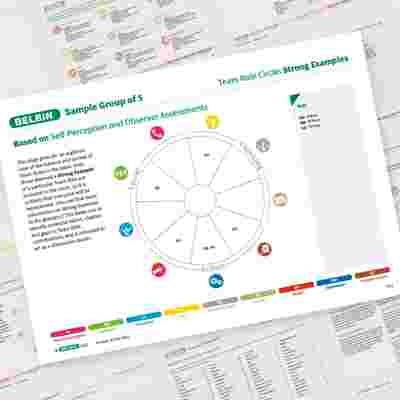
Belbin Team Report Team Role Circle Strong Examples Showcase

Turning Individuals Into Teams Using Data

When individual Belbin data is combined, it produces a Team Report that shows:

  • Who should contribute what
  • Where team gaps exist
  • Which behaviours dominate
  • Where strengths lie
  • How risk is distributed if a key person leaves

This shifts teamwork from guesswork to evidence based collaboration.


Teams can then create a Team Contract, which may include clarity around their shared purpose, agreed values, priorities, ways of working, approaches to decision making, how they will collaborate, how they intend to manage conflict and how they will celebrate success.

This can be developed through workshops, one to one conversations or by using a structured Team Canvas. Regardless of the format, the intention remains the same: to create alignment, clarity and shared accountability.

Sustaining High Performance

Teams do not reach high performance after one workshop. They require:

  • Regular review
  • Updated observer feedback
  • Revised agreements
  • Adjustment as context changes
  • Repeated focus on relationships as well as tasks

Objectives change, environments shift, and people evolve. High performance must be maintained intentionally.

Belbin LI Quotes9

Conclusion

We cannot control economic conditions or external uncertainty. But we can build teams capable of navigating complexity and performing at their best.

Belbin provides the language, data and framework needed to achieve this. It helps transform collections of individuals into aligned, self aware and adaptable teams.

Get in touch to book your free consultation

Speak to a Belbin expert about how your teams work and how behaviour impacts performance. On submission, one of our friendly team will get in touch within 24 hours. We look forward to meeting you!