Menu
member login contact link

How to... Build Lean Belbin Teams

Our guide on how you can align Belbin with Lean Six Sigma to produce not just balanced teams, but productive and efficient teams.

In order to do our best in a job, we need to be engaged: given meaningful and important work, offered responsibility and autonomy and recognised for our achievements. When we are stuck performing pointless tasks, wasting time waiting for something or dealing with problems which could have been avoided, frustration and apathy are often the results. 
 
Human beings should not be thought of either as “resources” (reminiscent of a type of stock or inventory) or liabilities to be managed in an effort to reduce risk. We interact with all manner of working processes, using common sense where machines can follow only logic, making improvements and adding a human touch. However, there is also a downside to the “human factor”. Miscommunications can slow things down. Conflict can throw things off track. In short, human error can be costly. Even  highly efficient people can hinder progress, if their productivity is compensating for a bureaucratic, time-consuming process – how much more might that person achieve if the process were reviewed and improved, rather than followed repeatedly?

One of the crucial concepts in the Lean Six Sigma methodology is the identification of waste.

Lean Six Sigma is a methodology designed to improve processes by streamlining and eliminating waste and defects – anything which is unnecessary or detracts from the efficacy of work. Its premise is that project teams can define a problem, derive ways to measure the effects of the problem and analyse data to arrive at potential solutions, which can be implemented. Once improvements have been made, measures are put in place to ensure that progress is maintained.
 
In many ways, Belbin and Lean Six Sigma share the same philosophy – helping organisations to become more effective by eliminating wasted effort at all levels of the business. Lean Six Sigma mainly focuses on processes, whereas Belbin helps to streamline human interaction at work, by giving people a common language to describe certain behaviours within the team. The two offer an exciting synergy which can transform business performance.

The identification of Wastes

One of the crucial concepts in the Lean Six Sigma methodology is the identification of waste. Lean defines waste as: “steps or actions in a process which are not required.”

The acronym DOWNTIME is used to break waste down in to 8 different types:

  • Defects – any errors or inaccuracies which occur; problems which cause customer dissatisfaction.
  • Overproduction – making more, earlier or faster than the next process needs.
  • Waiting – any kind of delay, whether waiting for other people, for a machine or for more information or materials.
  • Non-Utilised Talent – not using people’s experience, skills, knowledge or creativity to best advantage.
  • Transportation – unnecessary movement of materials around the organisation.
  • Inventory – having too much stock or supplies.
  • Motion – any movement of people which does not add value.
  • Extra-Processing – any effort which does not add value.

Using Belbin to reduce waste

Talent may be under-utilised because it is hidden or because it is in the wrong place. Where this prevents a team from working effectively, Belbin Team Roles can have a significant impact. Belbin identifies the positive behavioural contributions (or Team Roles) each person has to offer, so you can see how best to fit that individual into a project team. As a result, the team can use talent to best effect and ensure that all bases are covered. Let’s look at this in more detail.

Non-Utilised Talent: Using Belbin to reduce waste

Non-Utilised Talent can be defined as a failure to use people’s experience, talents, ideas, skills, knowledge or creativity. This type of waste can be caused by a number of factors, including:

  • Poor communication
  • Poorly or narrowly defined jobs and expectations
  • Lack of teamwork (or ineffective teamwork)
  • Lack of training (or provision of unsuitable training)
  • Poor management, especially failure to include employees in finding solutions to problems

These factors limit employee engagement, which ultimately has an adverse effect on the organisation. If people are able to play to their Team Role strengths, they are more likely to be engaged and take ownership of their roles. In Belbin terms, Non-Utilised Talent means individuals are being placed in situations where they are unable to play to their Team Role strengths. This could be for several reasons. Perhaps they lack awareness of where their talents lie, or because the constraints of a particular job role do not allow them to contribute as they would wish.

Instead of seeing Non-Utilised Talent as a waste, we could see it as an opportunity.

The question is: why aren’t people being utilised correctly?


Non-Utilised Talent: Could the talent be ‘hidden’?

Sometimes there may be a mismatch between an individual’s perception of his or her own contribution and the behaviours that others see.

According to Lean, when identifying potential root causes of a problem, it is important to consider all views and gather evidence from a range of sources, rather than adopting pet theories and assuming that a particular solution will work.

In the same way, the efficacy of measuring behaviour should not be limited to the perception of the individual in question. Sometimes we are not aware of our own strengths and others can help to point the way and identify areas for further development.

This evidence may be obtained by collecting Observer Assessments – Belbin feedback from colleagues and others who have worked closely with the individual for some time – and analysing the findings.

Team Roles in a Ranked Order

This page of the Belbin Individual report lists the individual’s Team Roles in order from most to least prominent, according to the individual and each observer.

Do the observers agree with the self? Do they agree with one another?

John Yellow Page 9 Showcase Belbin Team Role Report
John Yellow Page 5 Showcase Belbin Team Role Report

Comparing Self and Observer Perceptions

The page of the Belbin Individual report quantifies the degree of similarity and difference between the individual and observers. In cases where there are considerable differences, this could indicate that the individual in question aspires to play a certain role, or that the team sees strengths that the individual does not know he or she possesses.

Confirmation of existing strengths (or discovery of new ones) can bolster confidence and empower individuals to take greater ownership of their work.

Non-Utilised Talent: Could the talent be in the wrong place?

The misplacement of an individual can have a significant impact on employee engagement and, ultimately, on staff turnover. For example, an individual who has indicated Completer Finisher and Specialist preferences is likely to derive fulfilment from a role in which specific knowledge can be applied to refine and make improvements.

Placed in a role in which he or she is expected to take a “broad-brush” approach and in which the expertise in question is not valued, the individual is unlikely to excel and may be tempted to leave in pursuit of a job which offers a “better fit”.


Placement Suggestions

The Placement Suggestions and Suggested Work Styles pages from the Belbin Individual report offer advice as to the sort of work which might suit an individual, and the useful feedback form others – Observer feedback – helps to consolidate these suggestions by adding work that others feel they would be suited to.

John Yellow Page 7 Showcase Belbin Team Role Report
Belbin Team Report Potential Contributions Showcase

Non-Utilised Talent: Optimising talent in the team

It is not only important to utilise individuals effectively, but also to optimize the performance of the team as a whole.

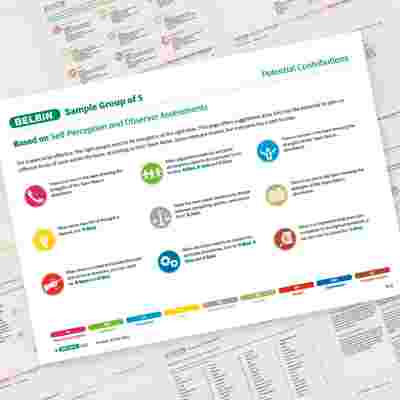
The Potential Contributions report advises which team members might be most suited to playing each Team Role and includes everyone in the team.

The page Comparison between Individual and Team from the Belbin Team report  provides more focus by identifying the highest-scoring individual for each role – the individual whose percentile score is shown on the blue bar.

Where there is a large difference between the two bars, this indicates that the team may be reliant on one individual to play a particular role.

If that individual leaves the team, their absence poses a potential risk to the team’s success, as might the removal of a key supplier.

Belbin Team Report Comparison Between Individual And Team Showcase

Time for DMAIC

Sharing and understanding this Team Role evidence can help to maximize the team’s chances of success, as individuals can be matched to appropriate tasks and responsibilities. As a result, people do not spend time and effort trying to play their weakest roles. It also reinforces the message that one person is not expected to cover all bases, but can and should seek assistance for those areas in which they feel less confident.

We began by exploring Lean’s “8 Wastes”, which can hinder the productivity of a team or organisation. We have looked at Under-Utilised Talent in particular and explored ways to reduce this waste, using Belbin Team Roles. 

Having eliminated waste, how can we use Belbin to drive improvement in business processes? Time for another acronym: DMAIC

In order to improve processes by minimising defects or DOWNTIME, Six Sigma proposes a method for analysing the root causes of problems and potential solutions, called DMAIC.

According to Six Sigma methodology, project teams are put in place to carry out the stages of DMAIC and then hand over the refined, streamlined process to a dedicated process team:

  • Define – create a project charter which clarifies the issue, determine who will be involved and any expectations or requirements. 
  • Measure – find out how bad the problem is by deciding on measurements and collecting the right data.
  • Analyse – determine the root causes of the problem and develop a hypothesis for making improvements.
  • Improve – address root causes; confirm improvements with data; introduce “mistake proofing” to reduce possibility of errors.
  • Control – celebrate and “storyboard” progress; put strategies in place to ensure that improvements are sustained.


DMAIC – how can Belbin be used?

In order for the method to be effective, it is important that project teams are set up correctly and that the team follows the appropriate stages.

DMAIC – how can Belbin be used?

Each Team Role has a positive contribution to make to DMAIC. This table offers some suggestions as to how to use Team Role strengths to enhance the effectiveness of the DMAIC process team, and also highlights some problems which may arise.

Define: Co-ordinator

Co-ordinators tend to tale a broad view, so are suited to identify needs and formulate the project charter.

Co-ordinator

Define: Shaper

Shaper's are deadline focused, so involve them in the Goal Statement and Timeline of Project Charter.

Shaper
Resource Investigator

Measure: Resource Investigator

Resource Investigators are ideally placed to gather information and ideas form outside the team (for example, customer's views), but not for methodical data collection, since they are likely to loose interst.

Implementer

Measure: Implementer

Implementers are best suited to more process-driven means of measurement.

Avoid using Plants during this phase since they are not generally suited to following processes.


Analyse: Plant

Plants are best placed to identify problems with current ways of working, but should not be allowed to hold on to “pet theories” when identifying root causes for problems. Not suited to strictly process-driven work (e.g. the Measurement phase). Owing to originality and unconventional working style, this role is the most likely to possess under-utilised talent.

Plant

Analyse: Monitor Evaluator

Monitor Evaluators are impartial and analytical, so well suited to analysing and exploring potential root causes of a problem, without jumping to conclusions or adopting “pet theories”. Useful for data collection planning in Measure phase and contingency planning during Control phase.

Monitor Evaluator

Analyse: Specialist

Specialists are useful resource members who can provide specific information which others cannot. Identification of root causes is likely to be limited by specialism or area of expertise. During “Analyse” phase, may wish to study data in great depth, so ensure this does not frustrate others or slow progress.

Ensure the Shaper is not permitted to rush this phase.

Specialist
Implementer

Improve: Implementer

Implementers are methodical and systematic, so are most likely to follow and understand existing processes. However, an efficient Implementer could be hiding (and compensating for) an inefficient process. Be sure to overcome the Implementer's resistance to change by involving them in the Improve phase, so that they can see that change will bring greater efficiency overall.

Completer Finisher

Improve: Completer Finisher

Completer Finishers are detail-focused, so they are suited to eliminating defects (e.g. inaccurate or incomplete products) and mistake-proofing in this phase.

Control: Monitor Evaluator

Involve Monitor Evaluators in contingency planning during this phase.

Monitor Evaluator

Control: Co-ordinator

When managing project ad process teams, use Co-ordinators to identify and use talent to best effect.

Co-ordinator

Control: Teamworker

Deploy Teamworkers to 'storyboard and celebrate the team's success, to reduce the threat of change and help Implementers adjust to new processes.

Teamworker

Control: Implementer

Adjust to plan new processes.

Implementer

Bear in mind...

  • Use Shapers throughout to keep things moving and prevent processes from stalling.
  • Communication is key. Use Co-ordinators and Teamworkers at any stage where information needs to be shared amongst the team and Resource Investigators to communicate externally.
  • Avoid including Completer Finishers in the early project stages, so as not to become bogged down in detail of problems and solutions. Owing to high standards and reluctance to delegate, they are a likely source of bottlenecks, which can disrupt flow.
  • Owing to their originality and unconventional working style, Plants are the most likely to possess Under-Utilised Talent.

Belbin Team Role approaches to Lean Six Sigma

Team Roles can be divided into three categories. It is useful to bear in mind that these types may take different approaches to the Lean process.

Social (Co-ordinator, Teamworker, Resource Investigator)

  • Those with prominent social roles are likely to emphasise the importance of effective communication and knowledge-sharing to avoid duplication and redundant effort.

Thinking (Plant, Monitor Evaluator, Specialist)

  • Those with prominent thinking roles are likely to take a considered approach to problem-solving, contemplating potential solutions and their implications.

Action (Implementer, Completer Finisher, Shaper)

  • Those with prominent action roles are likely to focus on process and task: working efficiently and accurately to achieve goals.
Belbin Team Role Circle Social Thinking Action 2023

Lean Six Sigma and Designing Project Teams – The Belbin Way

A project team is a team whose members may belong to different parts of an organisation, but are brought together for the purpose of a particular project. These teams may be disbanded once the project is complete. There are a few Belbin pointers to consider when designing project teams.
 
Size – although there are nine Team Roles, this doesn’t mean that you need nine people in the team, since individuals tend to have more than one preferred Team Role.  An ideal size for a team is 4-6 people. As numbers grow, the team becomes a group, with different associated characteristics and behaviours altogether.

Abundance – with certain Team Roles, it is fair to say that “a little goes a long way”, so overpopulation in a team is not a good idea. This could apply to any Team Role, but is especially notable for Plants (too many ideas competing for attention) and Shapers (potential for disruptive behaviour).

Flexibility according to project stages – whilst it is important to have a balance of Team Roles, not all Team Roles are required at every stage of the project. If a role is introduced at the wrong stage, this can have adverse consequences on the project. For example, a Monitor Evaluator should not be present at the initial “ideas” stage, since there is a risk that they might dampen enthusiasm and cause a potentially strong idea to be rejected too early. Instead, consider the idea of a “fluid” team where members join the team to make their contribution and drop out again when their stage of the project is at an end. If the team’s purpose alters, consider whether the Team Roles required should also change.

Lean Six Sigma also recognises that some team members may be permanent, whilst others are ad hoc, providing a particular resource.

For example, a Co-ordinator might be required as a permanent member to keep a broad overview and manage changes in the project charter and in team personnel.

By contrast, a Specialist or Resource Investigator might serve as a resource member – called in to provide specific expertise or information on how competitors are addressing the same problems.

Once the team begins to measure processes and collect data, the Resource Investigator may leave the team, as he or she is likely to lose interest.


Sustaining Progress – Using Belbin

Lean Six Sigma is not just about initiating change, but sustaining improvement. Contingency plans must be put in place to ensure that the team can monitor the new, refined process and address any dips in performance.
 
Behaviour can change, so it is important to review Team Role tendencies over time, to ensure that individuals and the group continue to work to best effect and to determine whether the process team needs to change or grow.

In conclusion…

When someone is in the wrong job, frustration, disillusionment and dysfunctional teams are often the results. 

In Lean terms, much effort is expended for little reward. Belbin uses the evidence of real-world behaviours to seek out talent and promote individual strengths.

Breaking the mould of static working and rigid bureaucracy, Belbin and Lean methodologies encourage flexible project teams which use each and every resource available to make things run more smoothly and improve business performance.

Get in touch to book your free consultation

Speak to a Belbin expert about how your teams work and how behaviour impacts performance. On submission, one of our friendly team will get in touch within 24 hours. We look forward to meeting you!