Menu
member login contact link

Why Observers matter

To learn and understand ourselves better, we need to broaden our perspective – to look at ourselves through a new lens.

It may sound obvious, but we need to move beyond what we already know.

It’s important that we’re open to receiving new information; that we look for this information in the right places, and that we interpret it correctly, so we can act on it.

Only then can we set about changing the way we work and communicate with others.

Book your free consultation
Hybrid Teams Don’T Fail Because Of Where People Work... They Fail Because Of How People Work.

Observing behaviour is at the heart of what we do.

When Dr Meredith Belbin’s research team set out to investigate why some teams succeed and others fail, they did it by observing teams in action. 

The team members in their study had already completed a number of personality and critical thinking tests, but those results didn’t tell the researchers everything they needed to know.

Using a method called Bales Analysis, the researchers made and coded observations on how the teams communicated and acted during a simulated business game. They took measurements every thirty seconds throughout weeks and months.

Why we use Observer Assessments

Gary Shewan, Learning & Development Business Partner at Legal & General Retail and recipient of the Princess Royal Training Award, explains why they use Belbin Team Roles at Legal & General.

"The Observer Assessments are essential, I think for the programme that we use it on the most, a big part of it is raising self awareness.

We've used lots of tools over the years and we had to go back to using Belbin because with the behavioural element, the observations, it just heightens peoples self-awareness." 

Belbin Team Role Circle Social Thinking Action 2023

The result? The original big data.

From their analysis, the nine Team Roles were discovered – nine key clusters of behaviour that were effective in facilitating team progress.

Having discovered that behaviour was key, it became equally apparent that the behaviours needed to be measured by others – by observers – to ground the findings in reality. In other words, the researchers couldn’t rely solely on the individuals themselves to provide the full picture.

Self-reporting isn’t the whole story

Many tools and tests rely on self-reporting. We answer questions about who we are: personality (which is fairly fixed), our internal thoughts and feelings, and even who we want to be.

These tools can make us feel really ‘seen’ and understood. There’s an instant ‘feel good’ factor. That’s because there’s really nothing to disagree with! In essence, we’re looking in a mirror and reflecting our own view back at ourselves.

But there are a couple of limitations with this kind of measurement.

  • For one thing, we might miss out on hidden strengths that others see in us. This is crucial information for growth.
  • Secondly, our own view can easily be distorted – by mood, limited self-awareness or even aspirations to work in a certain way.

Even for those who are self-aware, who we are at work can change: in response to colleagues, our environment, our functional roles, and other experiences in our lives. In other words, the picture we see may not be the one everyone else sees.

In order to make lasting, meaningful improvements to individual and team performance, we need everyone to be looking at the same picture. To solve team problems, we need a team perspective.

Book your free consultation
John Yellow Page 4 Showcase Belbin Team Role Report

So, how is Belbin different?

Belbin measures behaviour, not personality – what we do, not who we are.

And because behaviour can be observed by other people, we ask others in the team (colleagues, managers etc.) for feedback on those behaviours, via a short questionnaire called an Observer Assessment.

This is completed after the individual’s Self-Perception Inventory (or SPI), which is the self-reported part.

Considered and Constructive

Our sophisticated algorithms ensure that Observer feedback is considered and constructive. Then we compare individual and Observer views, and advise on any significant similarities or differences between the two.

In short, adding Observer feedback to a Belbin Report gives teams, managers and coaches a wealth of information to unpack. It helps people to understand how others experience their behaviours, and offers practical advice and strategies to hone strengths and build on latent talents.

John Yellow Page 5 Showcase Belbin Team Role Report

How does the Observer process work?

Once the Belbin questionnaire (the Self-Perception Inventory) has been completed, a participant can invite others to complete the shorter questionnaire – the Observer Assessment (OA).

  • We recommend inviting six Observers. To avoid bias, a minimum of four is required to produce a Belbin Individual Report incorporating Observer feedback.
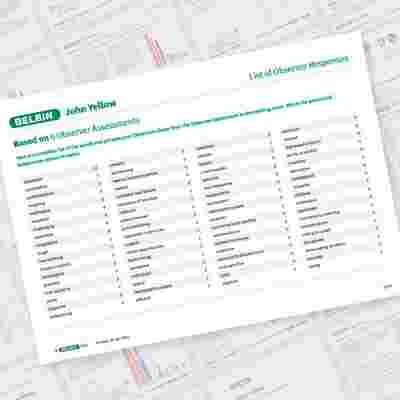
  • The Observer Assessment consists of two ticklists of adjectives – one positive and one negative. Observers simply select those characteristics they feel apply to the person being observed.
  • An ideal Observer is a colleague (not a family member or a friend) who has worked closely with the person for at least three months.
  • Observers should be prepared to provide honest feedback, on the understanding that it will aid the person’s personal development.
John Yellow Page 10 Showcase Belbin Team Role Report

What next?

Find out more about the Belbin Individual reports and how the Observer assessments are used. Click here.

If you are interested in finding out how you can use Belbin for your team or organisation, get in touch using the form below:


Get in touch to book your free consultation

Speak to a Belbin expert about how your teams work and how behaviour impacts performance. On submission, one of our friendly team will get in touch within 24 hours. We look forward to meeting you!

Discover individual and team strengths using Belbin Team Role reports

Banner Image Belbin Individual Report 2022 Subnav

Belbin Individual Reports

Before you can analyse your teams, you need to look at each individual's contribution. So, the first thing you will need to do is to generate a Belbin Individual report for each member of the team.

Find out more
Banner Image Belbin Team Report 2022 Subnav

Belbin Team Reports

Whether you're forming a new team, introducing new people to an existing team, or trying to resolve issues within a team, a Belbin Team report can help you to manage it.

Discover more
Why use Belbin SubNav

Why Use Belbin?

Belbin Team Roles are used to identify behavioural strengths and weaknesses in the workplace. Whether developing people, resolving conflict or fine-tuning high performance...

Read more