Resilience through a Belbin lens
Change has become a defining feature of working life.
Whether we're speaking to team leaders, management consultants, HR professionals or L&D specialists, we increasingly hear the same challenge.


Change has become a defining feature of working life.
Whether we're speaking to team leaders, management consultants, HR professionals or L&D specialists, we increasingly hear the same challenge.
The specifics vary.
For some organisations, it's growth and expansion. For others, restructuring, technological change, shifting customer expectations, economic uncertainty or increasing levels of complexity.
But the underlying question remains the same.
How can teams continue to perform when the environment around them is constantly changing?
This is, at its heart, a question of resilience.
Traditionally, resilience has often been viewed as an individual quality. The ability to cope with pressure, adapt to setbacks and remain effective during challenging times.
And individual resilience remains important.
However, workplace challenges are rarely experienced in isolation.
Projects are delivered by teams. Problems are solved by teams. Change is implemented through teams.
The question is no longer simply whether individuals are resilient.
It's whether teams can collectively adapt, recover, learn and continue delivering results when circumstances become difficult.
As organisational complexity increases, the importance of team resilience grows alongside it.
And resilient teams are increasingly becoming a competitive advantage.
For more than 40 years, Belbin has helped organisations understand what makes teams effective.
By identifying and harnessing different Team Role strengths, Belbin enables individuals to contribute more effectively and helps teams build stronger working relationships.
Many of the characteristics that underpin resilient teams have always been central to Belbin's approach:
In many ways, resilience is not a departure from the Belbin story.
It is a natural extension of it.
Because teams are more resilient when people understand one another, appreciate different approaches and can draw on a broad range of strengths when circumstances demand it.
To help practitioners, coaches, consultants and organisations respond to growing interest in resilience, we've developed two new reports:
The Individual Resilience report explores how a person's Team Role strengths may support resilience in the workplace.
Rather than offering generic advice, the report provides personalised guidance based on an individual's behavioural strengths.
It highlights:
The report provides practical insights that help individuals understand how they can draw on their natural strengths when facing uncertainty and adversity.
Download a sample Individual Resilience report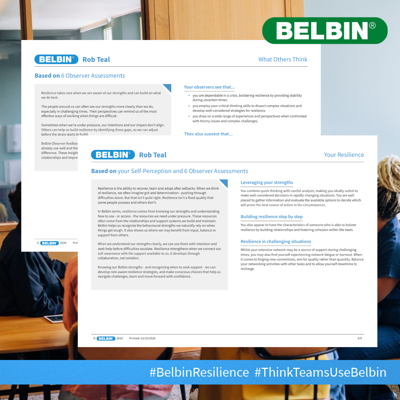
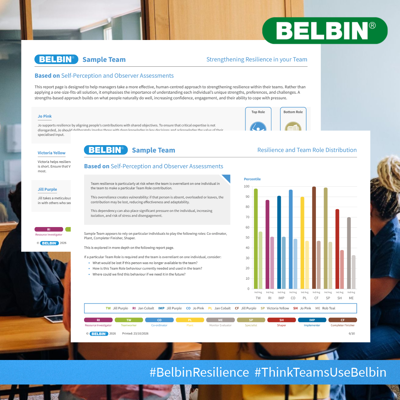
The Team Resilience Report examines resilience at a collective level.
Rather than viewing resilience solely as an individual trait, it explores how the balance of Team Roles within a team can influence its ability to respond to challenge and change.
The report helps teams understand:
By focusing on the team as a whole, the report provides a valuable framework for discussions about team effectiveness, adaptability and future readiness.
Download a sample Team Resilience reportTo find out more, please get in touch using the form below.