Menu
member login contact link

Which Team Roles make the best salesperson? Which profile is most suited to HR? What does an effective project manager look like?

We’re regularly asked these questions at Belbin.

Behind them lies a broader search for a secret formula: if certain behaviours are common in successful people or functions, can they be used as a blueprint for success?

Our Future of Teamwork 2027 report introduces our Team Role trends research, based on more than 20,000 Team Role profiles spanning 17 job functions, 22 industries and over 100 countries. This study reveals some fascinating patterns in how people tend to contribute within different working environments.

However, the real value of these findings is not in identifying the 'ideal' person for a role – or encouraging organisations to recruit more of the same. Instead, Team Role trends provide a starting point for understanding existing strengths, identifying potential gaps and appreciating the diverse contributions that enable teams to succeed.

Patterns can be informative, but they should never become prescriptions. The strongest teams are rarely built through conformity. They are built by bringing together different perspectives, strengths and approaches to achieve a shared goal.

What Team Role trends can tell us

Patterns can be useful because they help explain why departments and industries often approach work differently.

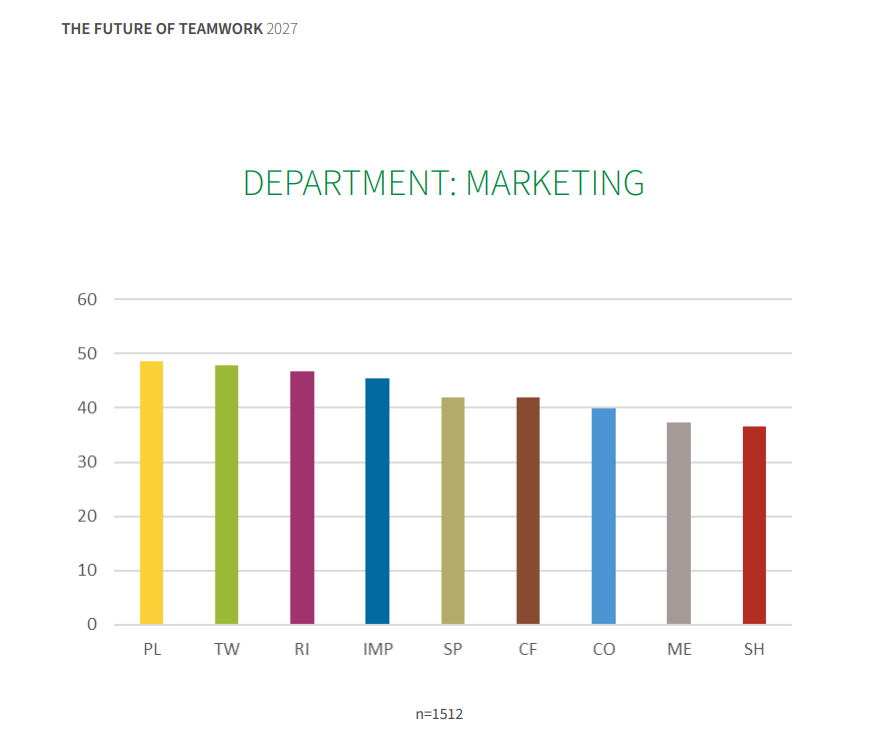
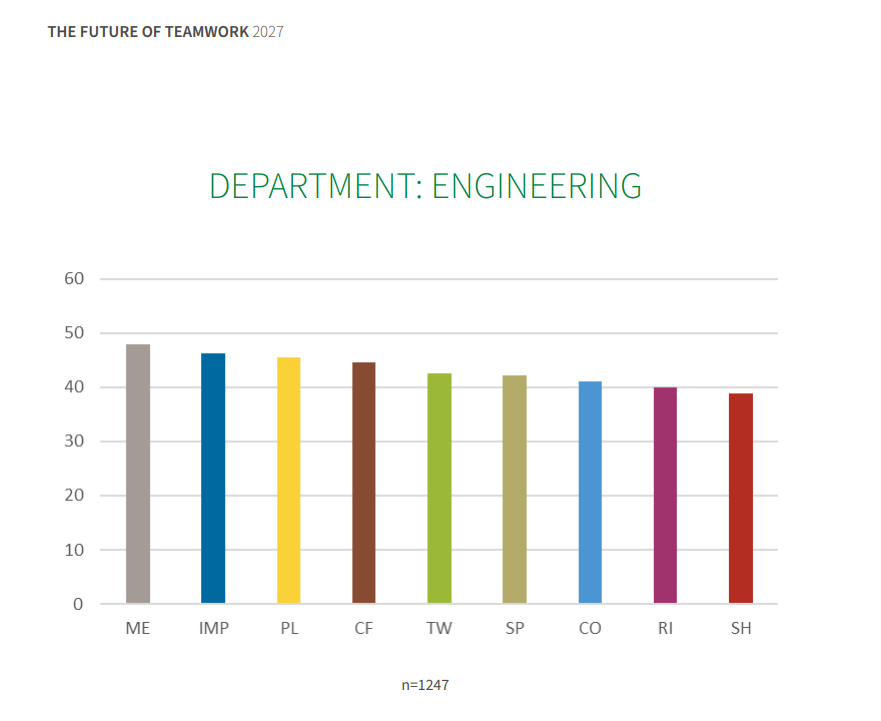
For example, accounting functions showed a predominance of Implementer and Completer Finisher behaviours, reflecting needs for accuracy, compliance and reliability. Marketing displayed stronger Plant, Teamworker and Resource Investigator tendencies, highlighting creativity, relationship-building and external awareness. Engineering combined analytical, practical and innovative styles through Monitor Evaluator, Implementer and Plant strengths.

These trends help explain how work is typically approached within a function. They can illuminate why some departments move quickly while others prefer careful analysis. They can also reveal why some areas of a business might prioritise relationships and collaboration, while others focus on process, quality or innovation.

Understanding these patterns has practical value. Leaders can anticipate potential blind spots, improve cross-functional collaboration and identify behavioural gaps that might affect decision-making or project delivery.

Organisations can use this data to recognise the behavioural forces shaping their culture, identify potential blind spots and consider which additional perspectives could strengthen performance. The greatest value comes not from creating more of the same, but from understanding where different contributions might add value.

The value of behavioural diversity

There is a temptation to look at high-performing industries or departments and ask, "What type of person succeeds here?"

The Belbin data suggests this is the wrong question.

A better question might be: "What behaviours are common here, and what might be missing?"

This distinction matters because Team Role trends describe what tends to be present; they do not define what should be present. There is no single ideal Team Role profile for an accountant, engineer, salesperson or HR professional. Different behavioural combinations can all lead to success, and some of the most valuable contributions come from individuals whose strengths differ from the established norm.

For example, if a department shows relatively low levels of Shaper behaviour, the answer is not to conclude that Shapers are unsuited to that function. Instead, it may prompt questions about whether teams in that department generally have enough drive to challenge inertia or maintain momentum. Likewise, a lack of Plant behaviour may highlight opportunities for greater creativity and fresh thinking.

If organisations only recruit people who reflect existing patterns, they risk reinforcing current ways of thinking while missing opportunities for improvement.

Diversity of behaviour introduces alternative perspectives, challenges assumptions and broadens collective capability and resilience.

Better recruitment, not narrower recruitment

Perhaps the most valuable application of Team Role trend data is in improving the quality of organisational questions rather than determining organisational answers.

Instead of hiring people because they match a departmental stereotype, organisations can use trend data to assess where diversity of contribution might create additional value.

If a marketing team is already rich in creativity and relationship-building strengths, it may benefit from more analytical challenge. If a finance team already excels in process and evaluation, it may benefit from people who introduce new ideas and alternative approaches.

This shifts recruitment away from cloning and towards complementarity.

A strategic lens for understanding culture

Behavioural insight is a strategic capability.

Understanding behavioural patterns can help organisations build balanced teams, develop talent, navigate change and enhance collaboration.

However, the greatest value lies in context.

Team Role trends reveal behavioural cultures that have developed within industries and functions. They help explain existing patterns of contribution. They do not provide blueprints for success, nor should they become criteria for excluding people whose strengths differ from the norm.

As our report concludes, some of the greatest opportunities for innovation and growth come from those whose contributions differ from established patterns. Diversity of thought and behaviour remains fundamental to effective teamwork.

Ultimately, Team Role trends are at their most powerful when used as a mirror rather than a mould. They help organisations understand who they are today, where behavioural gaps may exist, and how different strengths can combine to create stronger, more resilient teams.

The goal is not to reproduce existing profiles but to understand them, challenge them where necessary and build teams that harness behavioural diversity to drive higher performance.

This article is one of a series highlighting some of the findings from our soon to be launched report:

The Future of Teamwork 2027. From Research to Impact: Understanding People, Strengthening Teams, Improving Performance.

If you would like to be one of the first to receive a copy of the report when launched, please complete the form below.

You will be added to our mailing list. You can unsubscribe at anytime.

Sign-up
The Future Of Teamwork 2027 Front Cover

The Future of Teamwork 2027